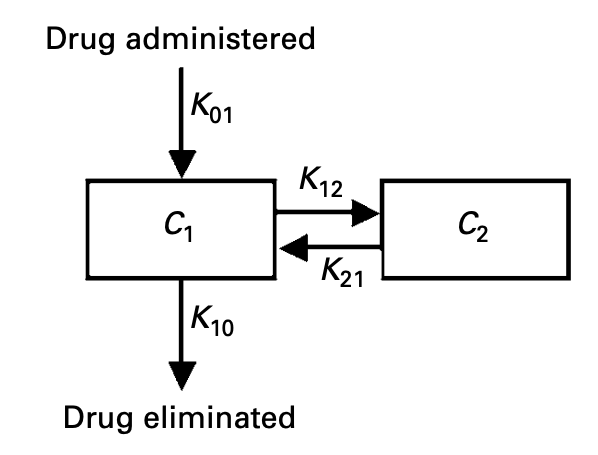
Adapted from Physics, Pharmacology and Physiology for Anaesthetists
- Where:
- C0 = 'outside compartment'
- C1 = central compartment
- C2 = peripheral compartment [representing less vascular tissues of the body]
- K01 = rate constant for a drug moving from C0 to C1 i.e. rate of administration of the drug
- K10 = rate constant of elimination from the central compartment
- K12 = rate constant for a drug moving from C1 to C2
- K21 = rate constant for a drug moving from C2 to C1
- The volume of distribution is the sum of the volumes of the two compartments (VD = V1 + V2)
- Elimination (removal of drug from plasma) only occurs from C1, and occurs either via:
- Removal of the central compartment
- Redistribution to C2
- A semi-logarithmic graph of ln(concentration) vs. time is no longer linear - it is a bi-phasic exponential decay curve
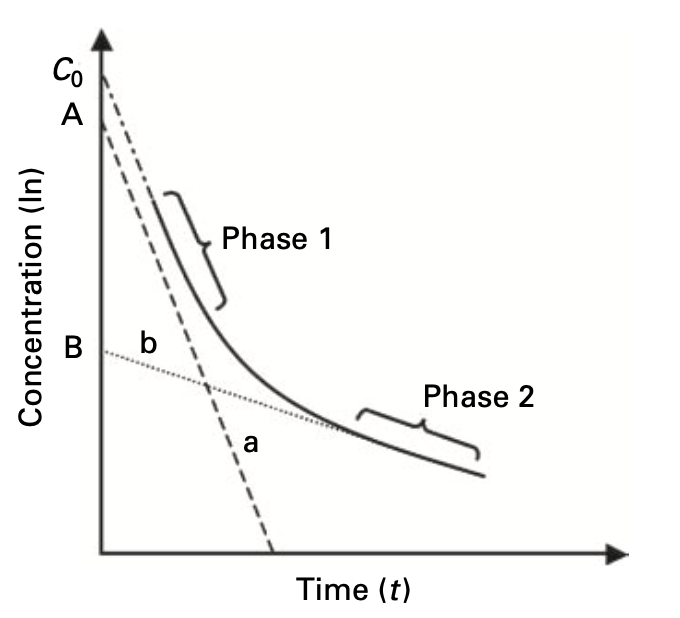
Adapted from Physics, Pharmacology and Physiology for Anaesthetists
- Phase 1 represents distribution of drug from C1 to C2
- The rate of this depends on the different concentration gradients and the rate constant for the transfer (K12)
- Phase 2 represents terminal elimination of the drug from C1
- The tangent to phase 2 (line b) intercepts the y-axis at point B
- (NB as a convention, line b always represents elimination from the body)
- Subtracting line b from the exponential curve gives line a
- Line a intercepts the y-axis at point A
- The initial drug plasma concentration (C0) = A + B
- As the y-axis is logarithmic, A is much larger than B, so A is close to C0