- Most anaesthetic drugs are accurately modelled using three compartment models
- Commonly used TCI models are three compartment models, and target set plasma concentration
- Some models allow effect-site targeting e.g. Eleveld, modified Marsh
- However, the clinical effects of drugs used in TCI is via their effect on the brain
- The 'effect' (brain) compartment is thus considered to be a separate compartment
- It is in equilibrium with the central compartment, but with a lag-time to account for blood-brain equilibration
- There is an elimination rate constant from the effect compartment (ke0) and a half life for equilibration (t1/2ke0)
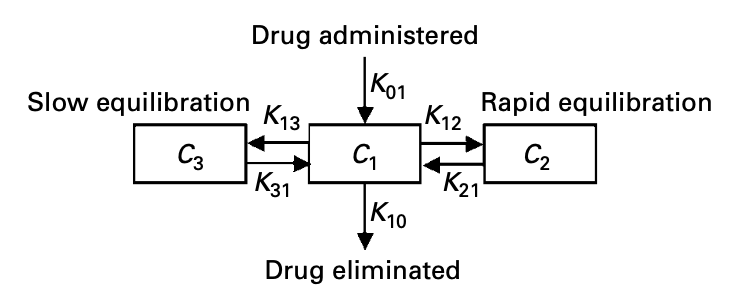
Adapted from Physics, Pharmacology and Physiology for Anaesthetists
- Where:
- C0 = 'outside compartment'
- C1 = central compartment
- C2 = peripheral compartment [representing less vascular tissues of the body]
- C3 = peripheral compartment [representing the least vascular tissues of the body]
- Rate constants for drug movement between all the different compartments are present
- The volume of distribution at steady state is the sum of the volumes of the three compartments
- As drug enters the central compartment, it is distributed along prevailing concentration gradients:
- Rapidly to the second compartment
- Slowly to the third compartment
- Peripheral compartments may act as reservoirs, keeping the drug concentration in the central compartment steady even as elimination occurs
- The ratio of the rate constants from the central to peripheral compartments therefore affects how quickly a drug will be fully eliminated
- Elimination still only occurs from C1
- A semi-logarithmic graph of ln(concentration) vs. time for a three compartment model is a tri-phasic exponential decay curve
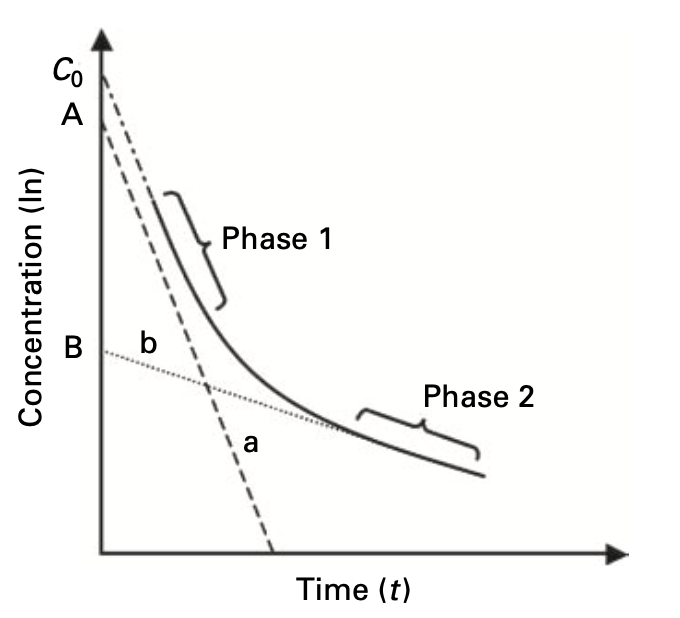
Adapted from Physics, Pharmacology and Physiology for Anaesthetists
- As before:
- Line a represents distribution to rapidly equilibrating tissues
- Line c represents distribution to slowly equilibrating tissues
- Line b represents terminal elimination from the body
- C0 = A + B + C
Ct = A.e-ɑt + B.e-βt + C.e-ɣt
- The term C.e-ɣt represents the distribution to slowly equilibrating tissues
- The term B.e-βt represents the terminal elimination phase