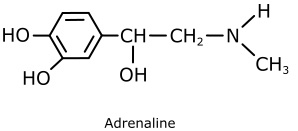
Adrenaline is a naturally occurring catecholamine sympathomimetic, produced exclusively in the adrenal medulla and released in response to sympathetic stimulation
Presentation
A clear, colourless solution of 1mg/10ml ("1 in 10,000") concentration
A clear, colourless solution of 1mg/1ml ("1 in 1,000") concentration
In auto-injectors ('epi-pens') at a concentration of 150μg/0.3ml or 300μg/0.3ml
Pre-mixed with the local anaesthetics lidocaine or bupivacaine: 1 in 80,0000 or 1 in 200,000 concentration
Pre-mixed 4mg adrenaline in 246ml 0.9% NaCl (16μg/ml concentration) for infusion
Adrenaline is chiral
The levo-adrenaline enantiomer is 15x more active than the dextro-adrenaline enantiomer
Most preparations contain approximately 99% levo-adrenaline, with 1% dextro-adrenaline as an impurity
Glass ampoules:
Contain sodium metabisulfite as an antioxidant
Contain sodium chloride, sodium citrate, citric acid monohydrate and hydrochloric acid to stabilise the molecule
Are often amber or brown, to prevent photodegradation by UV light into adrenochrome-melanin
Uses and doses
Adult cardiac arrest; 1mg bolus
Paediatric cardiac arrest; 10μg/kg bolus
Anaphylaxis
Adult
IM via auto-injector; 300μg
IM; 500μg
IV; 25-50μg
Paediatric
IM via auto-injector; 150μg
IM; 100 - 300μg depending on age
Nebulised to reduce airway oedema; 1mg in 2ml 0.9% NaCl
Topically to aid vasoconstriction e.g. adrenaline-soaked patties in surgery
Topical drops to eyes in closed-angle glaucoma
Prolong the duration of action of local anaesthetics
Increase the safe dosing threshold for local anaesthetics (lidocaine)
As part of a "fizzy mix" epidural solution with 2% lidocaine and sodium bicarbonate; 1 in 200,000
As an infusion in the critically unwell patient to provide cardiovascular support
Use a 4mg adrenaline in 246ml 0.9% NaCl (16μg/ml concentration) infusion at a starting rate of 0.05μg/kg/hr
As an infusion in the treatment of refractory anaphylaxis
Use a 1mg adrenaline in 100ml 0.9% NaCl (10μg/ml concentration) infusion at a starting of 5-10μg/kg/hr (0.5-1.0ml/kg/hr)
Absorption
pKa of 9.69
Not given orally as inactivated by COMT and MAO in the brush border of the intesine
IV > IM > SC absorption
Distribution
VD = 0.1-0.2 L/kg
12% protein-bound
Metabolism
Rapidly metabolised by either mitochondrial MAO or COMT (hepatic/renal/bloodstream)
Metabolites:
Vanillylmandelic acid - VMA (inactive)
Metadrenaline (active, further conjugated with glucuronidate/sulphate)
Excretion
Metabolites excreted in urine
Short half-life (2mins) due to rapid metabolism
Respiratory
Small increase in minute volume
Potent bronchodilator (although secretions may become more tenacious)
Pulmonary vascular resistance is increased
Cardiovascular
At low dose, β1 and β2 effects predominate
This makes it a positive inotrope with relative inodilatory properties
Increased cardiac output (although fall in DBP and PVR via B2 effect)
Myocardial oxygen demand/consumption increases and may cause ischaemia
Coronary artery dilation
Reduces threshold for arrhythmias
It has similar β1 affinity to noradrenaline
Adrenaline is a more potent inotrope than noradrenaline, however, because of its additional β2 effect
This increases force of contraction by a further 60% of its maximal β1 effect
It has β2 affinity greater than salbutamol, but less than isoprenaline
It has poor β3 affinity
At high dose (bolus or infusion), ɑ1 and ɑ2 effects dominate
Increases SVR
Should not be infiltrated into areas supplied by end-arteries and extravasation can cause tissue necrosis
Has similar ɑ-receptor affinity to noradrenaline
There may be downregulation of beta adrenoreceptors after infusions of >24hrs
Caution with halothane (as halothane sensitises myocardium to catecholamines); adrenaline dose restricted to 100μg in 10mins
Neurological
Increases MAC
Increases peripheral pain threshold
Renal
Moderate decrease in renal blood flow
Increased Na+ reabsorption in the tubules:
Direct stimulation of Na+ transport
Stimulating renin (and therefore aldosterone) production
Increased bladder sphincter tone may result in urinary retention
Metabolic
Increased BMR
Raised plasma glucose through glycogenolysis, lipolysis and gluconeogenesis → hyperglycaemia
Insulin secretion is initially increased (β2 effect) but is then over-ridden by the ɑ-effect that inhibits insulin release