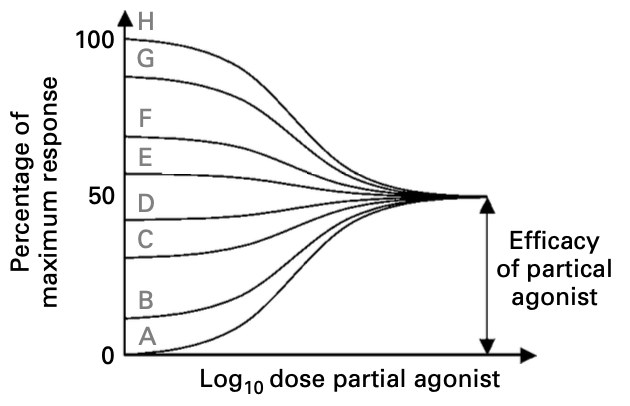
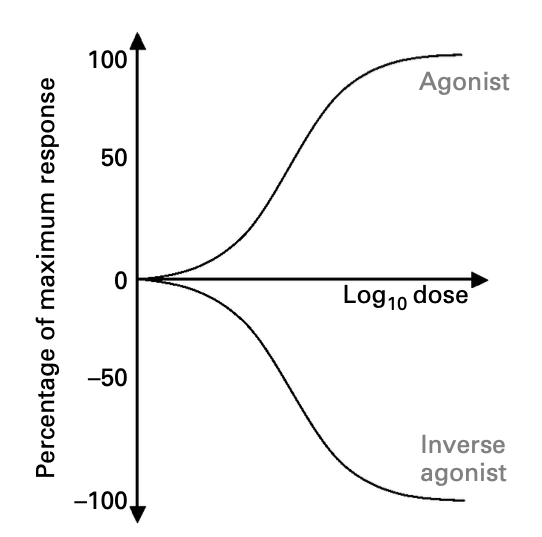
- A partial agonist can never produce a maximal response at a receptor, otherwise it would be a full agonist
- Partial agonists can have the same affinity for a receptor as a full agonist (although generally they have lower affinity for the receptor)
- If a partial agonist does have the same affinity for a receptor as a full agonist, it will have the same equilibrium constant (KA or KD)
Similar potency
Adapted from Physics, Pharmacology and Physiology for Anaesthetists
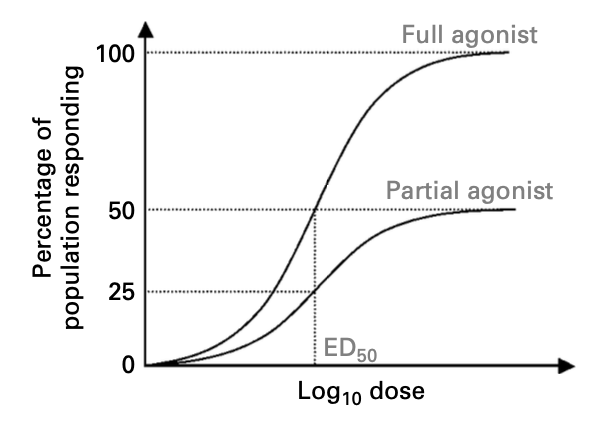
- This dose-response curve demonstrates the difference between a full and a partial agonist with similar potency
- The partial agonist demonstrates submaximal efficacy (i.e. unable to cause 100% population response)
- There is also a reduced gradient of the curve
- However, the potency (ED50) is similar; the best response the partial agonist can exert is 50% of the population, therefore its ED50 is at 25% response
Variable potency
Adapted from Physics, Pharmacology and Physiology for Anaesthetists
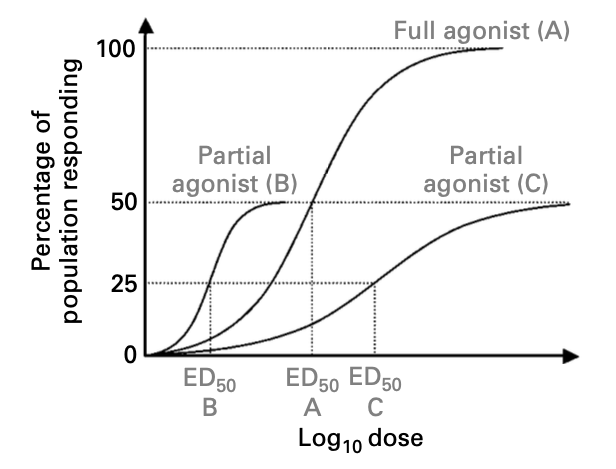
- This dose-response curve shows partial agonists with different potencies
- Partial agonist B has higher potency i.e. lower ED50, although its efficacy is still less
- Conversely, partial agonist C has a lower potency i.e. higher ED50, and also has lower efficacy