FRCA Notes


Anticholinesterases


  • Anticholinesterases occupy the active site, and therefore antagonise, the acetylcholinesterase (AChE) enzyme, usually responsible for the hydrolysis of acetylcholine (ACh)
    • The actions of anticholinesterases aren't limited to the NMJ, and may involve cause autonomic cholinergic effects (bradycardia, sialorrhoea)
    • Hence anti-cholinergic drugs such as glycopyrrolate and atropine are often given too

  • Anticholinesterases can be classified according to the reversibility of their binding to the acetylcholinesterase enzyme:
    1. Reversible, competitive
    2. Reversible, competitive enzyme carbamylators
    3. Irreversible, enzyme phosphorylators

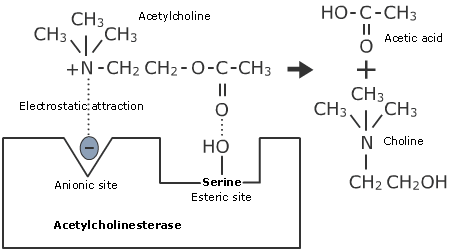
Acetylcholinesterase enzyme

Adapted from E-learning for Health

  • Rapidly hydrolyses acetylcholine into choline and acetic acid
  • Contains two binding sites:
    1. The Anionic site
    2. The Esteratic site

  • The Anionic binding site contains a negatively charged glutamate
    • This binds reversibly via electrostatic attraction to the positively charged quaternary amide on the choline portion of acetylcholine

  • The Esteratic binding site contains serine amino acids that hydrolyse acetylcholine
    • The enzyme is temporarily acetylated
    • Choline is reabsorbed via presynaptic transporters, where it is recycled
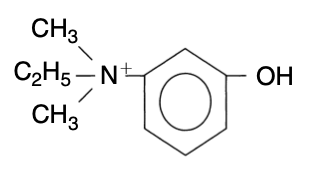
  • Edrophonium is a competitive, reversible acetylcholinesterase inhibitor
  • It is a phenolic quaternary amine
Edrophonium structure

Mechanism of action

  • The quaternary amine group is attracted to the anionic site
  • The hydroxyl (phenol) group forms a hydrogen bond to stabilise the molecule
  • Acetylcholine is unable to reach the AChE active site
    • As ACh competes with edrophonium a true covalent bond isn't formed
  • Edrophonium also increases ACh release

Uses

  • Tensilon test for diagnosis of myasthenia gravis
    • 2mg followed by 8mg if no improvement in muscle strength as detected by EMG

  • To distinguish between:
    • Myasthenic crisis - muscle power is improved
    • Cholinergic crisis - muscle power is worsened
    • Lambert-Eaton syndrome - no change in muscle power

Pharmacokinetics

  • Low lipid solubility due to quaternary nitrogen
    • Not absorbed orally
    • Does not cross BBB or placenta
  • Faster onset of action than neostigmine
  • Excretion
    • 65% - unchanged in urine
    • 35% - glucuronidation in liver and excretion in bile

Side-effects

  • Muscarinic side-effects:
    • Bronchoconstriction
    • Bradycardia
    • Miosis and blurred vision
    • Sialorrhoea, peristalsis, N&V

  • A.k.a carbamate esters, acid-transferring AChE inhibitors and time-dependent AChE inhibitors
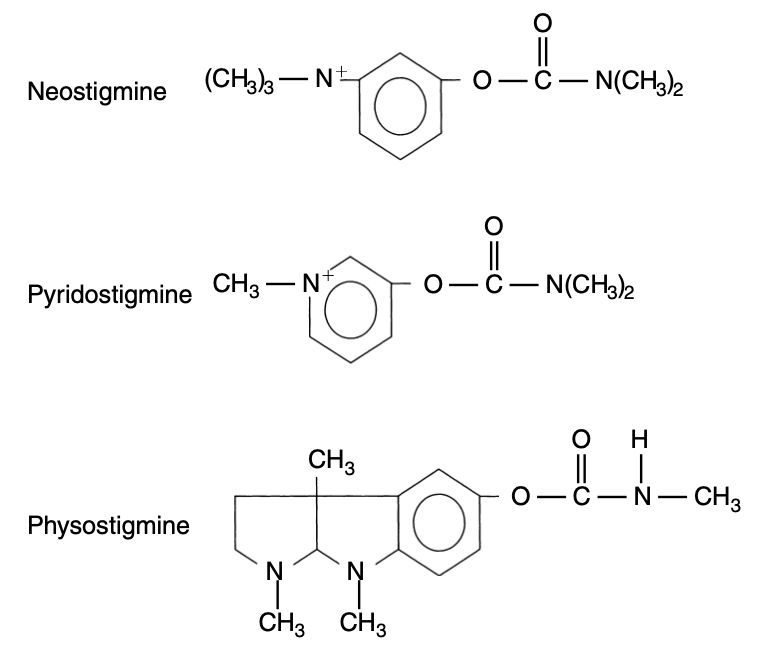
  • Examples include neostigmine, pyridostigmine and physostigmine
Carbamate esters
  • Bind to both esteratic and anionic sites
  • Are hydrolysed when they react with AChE

  • Although acetylcholine acetylates the enzyme when it is hydrolysed, these molecules produce a carbamylated enzyme
  • The carbamylated enzyme reacts with water more slowly
  • This reduces the rate of ACh breakdown, increasing concentrations in the synaptic cleft

Neostigmine

  • A quaternary amine

  • Uses and presentation:
    • A solution ± glycopyrrolate to reverse the effect of competitive, non-depolarising NMBA once TOF >2 (50μg/kg IV)
    • Tablets to treat myasthenia gravis (15-30mg PO, effects last 4hrs) and urinary retention
    • As an infusion for refractory constipation on ICU and paralytic ileus

  • Pharmacokinetics
    • Poorly absorbed, low oral bioavailability (1-2%)
    • Minimally protein bound (10%) and low volume of distribution (<1L/kg)
    • Metabolised by plasma esterases
    • Excreted 53% unchanged in urine and 47% in liver

  • Pharmacodynamics
    • Respiratory - may precipitate bronchospasm in asthmatics
    • Cardiovascular - may precipitate bradycardia and hypotension
    • CNS - miosis and blurred vision
    • GI - sialorrhoea, increased gut motility/peristalsis, nausea and vomiting
    • At high doses large amounts of ACh at the NMJ can block neuromuscular transmission by flooding the receptors
    • Also inhibits plasma cholinesterase and can therefore prolong the action of suxamethonium

Pyridostigmine

  • A quaternary amine
  • Mainly used for the treatment of myasthenia gravis as it has a longer half life and fewer autonomic effects than neostigmine
  • Patients with MG taking pyridostigmine are therefore relatively insensitive to succinylcholine, but relatively sensitive to non-depolarising NMBA

  • Pharmacokinetics
    • Slower onset but longer duration than neostigmine
    • Does not cross BBB
    • 75% excreted unchanged in the urine

Physostigmine

  • A tertiary amine
  • Historically used to treat anticholinergic poisoning
  • Well absorbed from GIT and crosses BBB

  • Mainly refers to organophosphates
  • Highly toxic compounds used as:
    • Insecticides e.g. TEPP (tetraethylpyrophosphate)
    • Treatment of glaucoma e.g. ecothiopate iodide - relaxes the ciliary muscle and improves drainage of the trabecular network
    • Chemical warfare agents e.g. sarin nerve gas, Novichok

  • Compounds are highly lipid soluble and are absorbed across skin

Mechanism of action

  • Phosphorylate the esteratic site
  • This inhibits AChE activity
  • The complex formed is very stable and resistant to hydrolysis or reactivation
  • The phosphorylated enzyme reacts with water even more slowly, causing ACh concentrations to rise centrally and peripherally
  • Also inhibit plasma cholinesterase

Toxic effects

  • Nicotinic and muscarinic effects
  • Autonomic instability
  • Initial central excitation followed by central depression, coma and apnoea

Management

  • Pralidoxime (and obidoxime) are 'oximes' that promote hydrolysis of the phosphate at the esteratic site
    • They remain bound, allowing clearance of the poison
    • Best if used within 36-48hrs of poisoning as after that the enzyme becomes aged
  • Atropine, anti-convulsants and ventilation may also be necessary
  • Without treatment, recovery is dependent on the synthesis of new AChE molecules