FRCA Notes


Bupivacaine


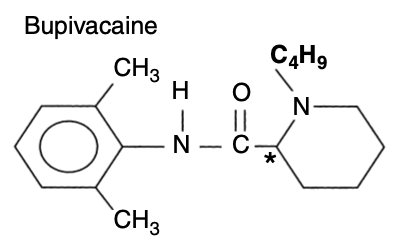
  • Bupivacaine is an amide local anaesthetic which contains a chiral carbon
  • Has a butyl group on its piperidine nitrogen
Bupivacaine chemical structure
  • Presents as a racemic mixture of the S- and R-enantiomers
  • Comes as solutions of 0.125%, 0.25% and 0.5% solutions ± 1:200,000 adrenaline
  • NB adrenaline does not alter safe dose of bupivacaine, which remains 2mg/kg
  • Can be mixed with 80mg/ml glucose to form heavy bupivacaine (specific gravity 1.026) for use in spinals

Levobupivacaine

  • An enantiopure preparation of S-bupivacaine
  • Reduced toxicity when information from animal studies and human volunteers is extrapolated, because:
    • The dose required to produce myocardial depression is higher
    • The excitatory CNS effects occur at a higher dose than bupivacaine

Absorption

  • pKa 8.1
  • Means only 15% unionised at physiological pH, giving it a slow onset time

Distribution

  • 95% protein bound
  • Relative lipid solubility vs. cocaine: 1000x (therefore 8x potency)
  • Toxic doses:
    • Plasma concentration: >1.5μg/ml
    • Dose: 2mg/kg (unchanged by adrenaline)

Metabolism

  • Hepatic dealkylation to pipecolic acid and pipecolylxylidine

Excretion

  • Elimination half-life 160mins