- Analgesic at doses of 15-60mg
- Anti-tussive
- Anti-diarrhoeal
- Hypnotic/anxiolytic
- Use in those <12yrs old restricted because of the risk of morphine toxicity
Codeine and Dihydrocodeine
Codeine and Dihydrocodeine
- Codeine is 3-methylmorphine, a naturally occurring morphine pro-drug
- It is 10x less potent than morphine
- Not suitable for use in severe pain
Absorption
- The methyl group reduces the 1st pass metabolism and therefore has a higher oral bioavailability (50%) than morphine
Metabolism
- 5 - 15% is excreted unchanged in the urine
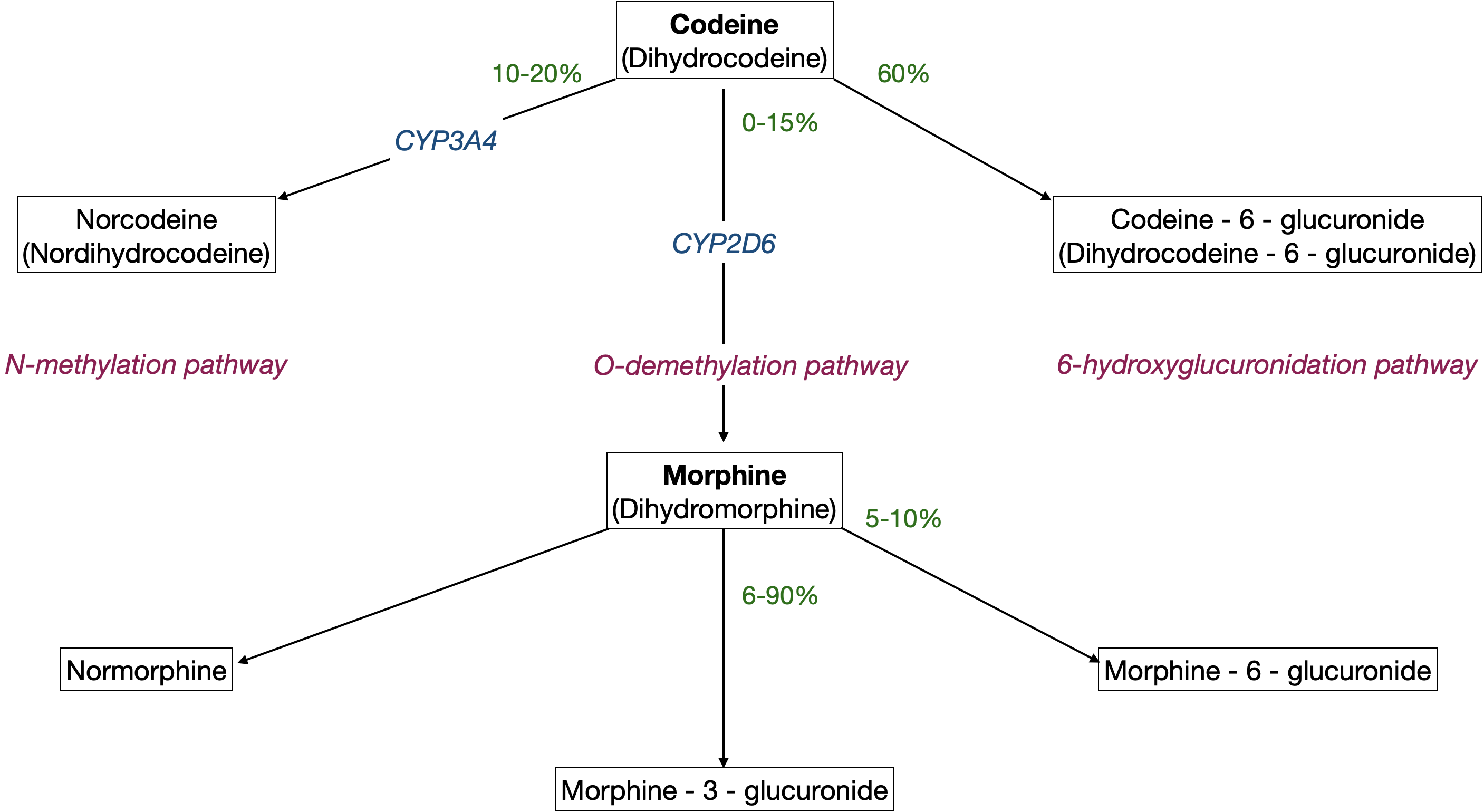
- O-demethylation to morphine is dependent on non-inducible CYP2D6 enzyme activity
- Ultrafast metabolisers generate increased amounts of morphine and therefore its (side-) effects
- Poor metabolisers (enzyme absent in 7-10% of Caucasians, 1-3% of non-Caucasians) experience little analgesia
- Of codeine's metabolites, only morphine has any significant MOP receptor activity
- Dihydrocodeine is a synthetic opioid
- It is structurally similar to codeine although 2x as potent (i.e. 5x less potent than morphine)
- It has poor (20%) oral bioavailability
- It is less dependent on CYP2D6 for its effects and has a greater efficacy at the MOP receptor than codeine
- Its effects are therefore more predictable than codeine
- Metabolic pathway as for codeine