FRCA Notes


Drug-Receptor Interactions


  • A ligand is a chemical messenger that binds to a receptor; it may be endogenous or exogenous (i.e. a drug)
  • A receptor is a cellular component that selectively interacts with a compound, to initiate the biochemical change that produces the effect of that compound

  • When a drug binds to the recognition site on a receptor, it may:
    • Elicit the naturally-occurring effect of ligand binding (agonism)
    • Prevent the natural ligand from binding, preventing the effect occurring (antagonism)
    • Induce an opposite or constitutive effect (inverse agonism)

D + R ⇄ DR

  • When a drug (D) binds a receptor (R) it forms a drug-receptor complex (DR)
  • It is assumed that the magnitude of the response is proportional to the concentration of DR

  • The law of mass actions states that the rate of the reaction is proportional to the concentration of the reacting components

  • Law of Mass Action
  • Where:
    • Kf is the rate of the forward reaction
    • Kb is the rate of the backward reaction
    • [D], [R] and [DR] are the concentrations of the drug, receptor and drug-receptor complex respectively

  • It is a specific, saturable and concentration-dependent interaction
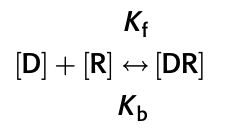

Law of Mass Action

Affinity constant

  • At equilibrium, the rate of the reactions will be the same, i.e.:
  • Kf [D].[R] = Kb [DR]


  • The affinity constant reflects the strength of drug-receptor binding
  • It has the symbol KA (units: L/mmol)
  • KA = Kf / Kb

Dissociation constant

  • The dissociation constant represents the tendency of the drug-receptor complex to split into its constituent drug and receptor components
  • It has the symbol KD (units: mmol/L)
  • KD = Kb / Kf

  • KD is, however, often described in terms of [D], [R] and [DR] instead:
  • Kf [D].[R] = Kb [DR]

    Kb / Kf = [D].[R] / [DR]

    KD = [D].[R] / [DR]


  • If a drug has a high affinity for the receptor, the [DR] at equilibrium will be high and thus KD will be small
  • If a drug has a low affinity, the [D].[R] at equilibrium will be high and thus KD will be large

  • If a drug occupies 50% of its receptors at equilibrium, then [R] = [DR] and these terms cancel out
  • In this state, KD=[D]
  • Therefore one can define KD as the molar drug concentration at which 50% of its receptors are occupied at equilibrium (mmol/L)