Enflurane


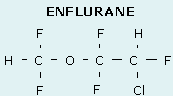
  • Enflurane is a halogenated ethyl methyl ester
  • It has a chiral carbon and is a structural isomer of isoflurane
  • It has largely been superseded by other agents
Time constant graph

MAC Blood:gas coefficient Oil:gas coefficient Molecular weight Boiling point SVP at 20ºC Safe ppm
1.7% 1.9 98 184.5 56.5ºC 23.3kPa 50
  • Non-irritant

Metabolism

  • 2% metabolised by CYP2E1 subfamily to inorganic and organic fluorides
  • Fluoride ions are nephrotoxic therefore to be avoided in renal failure

Respiratory

  • Significant reduction in VT and therefore increases PaCO2

Cardiovascular

  • Causes:
    • Reduced myocardial contractility and therefore cardiac output
    • Reduced SVR
  • Reflex tachycardia suggests carotid sinus baroreceptor reflex is preserved
  • Net effect is a reduction in mean arterial pressure

  • Some reduction in splanchnic blood flow
  • Does sensitise myocardium to catecholamines

Neurological

  • Increases CBF and reduces CMRO2
  • At high concentrations causes 3Hz spike & wave activity on EEG, consistent with grand mal activity
  • Significant potentiation of muscle relaxation and some uterine relaxation
  • Purportedly some analgesic properties

  • The -CHF2 group may react with dry soda lime or baralyme to produce carbon monoxide
  • If a circle system is left with dry gas circulating, subsequent use of enflurane may cause carbon dioxide release