- With regards to pharmacokinetics, it occurs because, at any given time, there is a difference between the concentration of a drug in the plasma and at its effector site (the biophase)
- Factors affecting this time lag include:
- Lipid solubility
- Degree of protein binding
- Degree of ionisation
- Concentration gradients
- Multiple patient factors
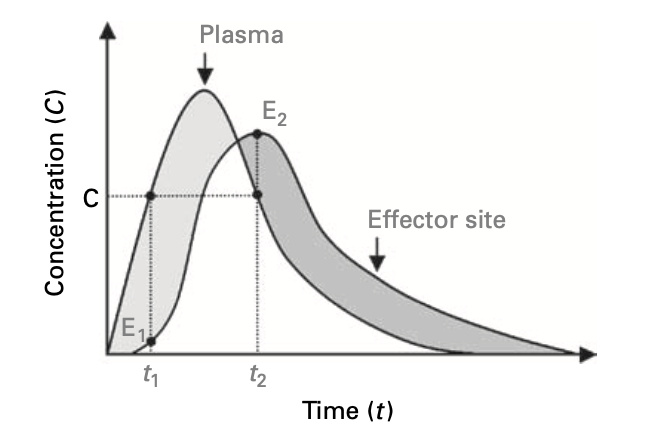
- After a drug is administered orally, its plasma concentration rises then falls with time
- The plasma concentration of a drug (C) is the same at two different points in time: t1 and t2
- The effect site concentration (E) of the drug lags behind the plasma concentration, based on the factors listed above
- This demonstrates hysteresis: the effector site concentration of a drug is different (E1 vs. E2) depending on whether the plasma concentration is rising (t1) or falling (t2)
- I.e. the measurement (effect site concentration, E) differs from the input value (plasma concentration, C) by different degrees depending on whether the input value is increasing (t1) or decreasing (t2) in value at that time
Adapted from Physics, Pharmacology and Physiology for Anaesthetists