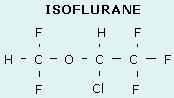
Isoflurane


  • Isoflurane is a halogenated ethyl methyl ester
  • It has a chiral carbon and is a structural isomer of enflurane
Time constant graph

MAC Blood:gas coefficient Oil:gas coefficient Molecular weight Boiling point SVP at 20ºC Safe ppm
1.2% 1.4 98 184.5 48.5ºC 33.2kPa 50
  • Irritant
  • Pungent smell

Metabolism

  • 0.2% metabolised by CYP2E1 subfamily
    • Trifluoroacetic acid
    • Inorganic fluoride ions

Respiratory

  • Pungent smell may cause irritability, coughing and breath-holding
  • Significant reduction in VT and therefore increases PaCO2
  • Causes some bronchodilation

Cardiovascular

  • Causes:
    • Reduced myocardial contractility and therefore cardiac output
    • Reduced SVR
  • Reflex tachycardia suggests carotid sinus baroreceptor reflex is preserved
  • Net effect is a reduction in mean arterial pressure

  • May have myocardial protective properties via effects on ATP-dependent K+ channels

  • Can cause Coronary Steal Syndrome
    • Normally responsive coronary arterioles vasodilate
    • Unresponsive/diseased arterioles don't vasodilate
    • Blood is diverted away from diseased arterioles, causing worsening ischaemia
    • May not occur if coronary perfusion is maintained

Neurological

  • Reduces CMRO2
  • Increases CBF when MAC >1, otherwise preserves autoregulation
  • Can cause burst suppression on EEG
  • Significant potentiation of muscle relaxation and some uterine relaxation
  • Purportedly some analgesic properties

  • The -CHF2 group may react with dry soda lime or baralyme to produce carbon monoxide
  • If a circle system is left with dry gas circulating, subsequent use of isoflurane may cause carbon dioxide release
  • Enflurane and desflurane also possess -CHF2 groups and may react similarly