FRCA Notes


General Principles of Local Anaesthetic Pharmacology


  • Local anaesthetics are all weak bases
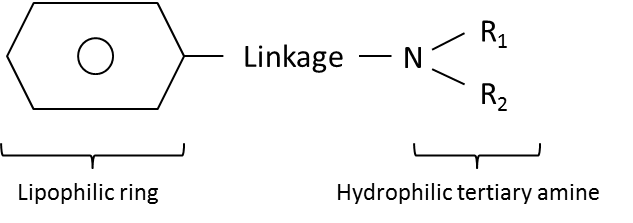
  • All are formed from a lipophilic ring (aromatic group) and a hydrophilic tertiary amine that are linked:

  • Generic chemical structure of local anaesthetics
  • Increasing the length of the carbon chain at any point in the molecule increases its lipid solubility, potency and duration of action
  • The linkage can be either:
    1. An ester linkage
      • Examples include amethocaine (tetracaine), procaine and cocaine
      • Esters are comparatively unstable in solution

    2. An amide linkage
      • Examples include lidocaine, prilocaine, chloroprocaine, (levo)bupivacaine and ropivacaine
      • Amides have a long shelf-life of approximately 2yrs
  • Local anaesthetics are formulated as the hydrochloride salt to make them water soluble
  • Only single-dose preparations without additives are safe for spinal techniques, as preservatives may cause arachnoiditis

Additives

  • Preservatives
    • Sodium metabisulfite (preservative)
    • 1mg/ml methyl parahydroxybenzoate (in multi-dose bottles)
    • A fungicide

  • Glucose 80mg/ml (e.g. 'heavy' bupivacaine)

  • Vasoconstrictors
    • Adrenaline 1:80,000 - 1:200,000
    • Felypressin (a synthetic vasopressin analogue)

  • Unionised, lipid-soluble drug passes through the phospholipid membrane into the nerve's axoplasm
  • It is protonated within the axoplasm

  • The protonated, ionised form binds the internal surface of voltage-gated sodium channels
    • This prevents voltage-gated sodium channels from leaving the inactive state
    • In vitro the degree of blockade is proportional to the rate of stimulation as there is greater affinity to 'open' sodium channels

  • An alternative theory postulates that unionised drug dissolves into phospholipid membrane, causing swelling of the voltage-gated sodium channel/lipoprotein matrix and thus inactivation


Drug pKa Unionised at pH 7.4 (%) Onset Protein binding (%) Duration Lipid solubility Relative potency Elimination half-time (mins) Toxic plasma conc. (μg/ml)
Lidocaine 7.9 25 Fast 70 Moderate 150 2 100 5
Bupivacaine 8.1 15 Moderate 95 Long 1000 8 160 1.5
Ropivacaine 8.1 15 Moderate 94 Long 300 8 120 4
Prilocaine 7.7 33 Fast 55 Moderate 50 2 100 5
Amethocaine 8.5 7 Slow 75 Long 200 8 80 -
Cocaine 8.6 5 Moderate 95 Short 1 1 100 0.5

Onset of action

  • Relates to pKa
  • Higher pKa = higher fraction ionised at pH 7.4 = less able to penetrate phospholipid membrane and slower onset of action
  • Conversely, lower pKa = faster onset of action

  • Smaller MW molecules will also diffuse into the neurone more quickly

Duration of action

  • Closely related to protein binding
  • The more extensive the protein binding, the longer the duration of action
  • Ester LA's are rapidly broken down by plasma esterases and therefore have a shorter duration of action than amide LA's

Potency

  • Closely correlated with lipid solubility in vitro (less so in vivo)
  • Other factors that determine quantity of LA at the nerve will impact on potency:
    • Vasodilator properties
    • Tissue distribution

  • Local anaesthetics are generally ineffective in infected tissue because:
    • The acidic environment increases ionisation and therefore limits drug available to diffuse into the nerve
    • There is generally increased local vascularity/blood flow, leading to increases removal of the drug from the site

Vasodilator activity

  • The degree of vasodilation varies between drugs but will affect potency and duration of action
  • In general, local anaesthetics cause:
    • Vasodilation in low doses
    • Vasoconstriction in high doses
  • The exception to this is cocaine, which is vasoconstricts in all circumstances through inhibition of MAO, inhibiting re-uptake of catecholamines
  • Prilocaine has the highest degree of vasodilator property, followed by lidocaine - bupivacaine and ropivacaine have relatively low vasodilatory properties

Cardiovascular

  • Lidocaine has Class Ib anti-arrhythmic properties, though other LAs do not

  • Both lidocaine and bupivacaine:
    • Block cardiac Na+ channels, reducing the maximum rate of increase of phase 0 of the cardiac action potential
    • Cause direct myocardial depression (bupivacaine > lidocaine), although main action causing hypotension is peripheral vasodilation
    • Prolong PR and QRS intervals
    • Prolong the refractory period
    • Disruption of K+ and Ca2+ channels may also contribute to arrhythmia

  • However, as bupivacaine is 10x slower at dissociating from the Na+ channels, it causes persistent myocardial depression
    • This may lead to VF or other re-entrant arrhythmias
    • The tachycardia may enhance frequency-dependent blockade by bupivacaine

  • Ropivacaine is less cardiotoxic than bupivacaine as it:
    • Dissociates more rapidly from sodium channels
    • Causes less direct myocardial depression
  • However as ropivacaine has a shorter duration of action and reduced potency, a larger dose is required for an equivalent block

CNS Toxicity

  • Local anaesthetics penetrate the brain rapidly and have a biphasic effect:
    1. Excitatory phenomenon due to blocking of inhibitory neurones
      • Peri-oral tingling, visual disturbance, tinnitus, tremors → seizures

    2. Depressant phenomenon due to blocking of all central neurones
      • Apnoea and coma

Other toxicities

  • O-toluidine metabolite of prilocaine may cause methaemoglobinaemia
  • Chondrotoxicity can occurs with intra-articular injection of LA
  • Lidocaine not used for intrathecal injection due to risk of transient neurological symptoms (TNS)
  • One of the main metabolites of ester LAs is para-aminobenzoate that is linked to hypersensitivity reactions (especially in the atopic patient)

Absorption

  • Degree of absorption varies by:
    • LA characteristics including inherent vasoactive properties
    • Presence of vasoconstrictors
    • Dose administered
    • Rate of administration
    • Site of administration:
      • Intercostal (inc. intrapleural) injection leads to the highest systemic concentration
      • Followed by epidural/caudal block, where there is also high risk of inadvertent intra-vascular injection
      • Followed by brachial plexus block
      • Subcutaneous use has the lowest systemic concentration

Distribution

  • Ester LA's are minimally protein bound in the plasma and do not cross the placenta in significant quantities due to their rapid metabolism

  • Amide LA's are more extensively protein bound (bupivacaine > ropivacaine > lidocaine > prilocaine)
  • Alpha - 1 - acid glycoproteins bind LAs (weak bases) with high affinity
  • However, albumin binds the greatest quantity of LA overall due to its abundance

  • Increased protein binding (e.g. pregnancy, infancy, renal failure, post-operatively, in MI) will reduce the free fraction of the drug

  • The degree of protein binding affects placental transfer:
    • Increased binding = less crosses placenta
    • If foetus becomes acidotic, the LA may return to ionised form and become trapped in the foetal circulation (ion trapping)

Ester metabolism and elimination

  • Rapidly hydrolysed by plasma cholinesterases and other esterases to inactive metabolites; elimination half-life is short
  • One of the main metabolites is para-aminobenzoate that is linked to hypersensitivity reactions (especially in the atopic patient)
  • Cocaine is the exception, undergoing hepatic hydrolysis to water-soluble metabolites that are excreted in the urine

Amide metabolism and elimination

  • Undergo hepatic metabolism by amidases
  • As such hepatic dysfunction or reduced hepatic blood flow will reduce amide metabolism
  • Have a much slower metabolism than ester hydrolysis and will accumulate in infusion, hepatic or renal dysfunction or reduced hepatic blood flow