FRCA Notes


Pharmacokinetic Modelling Principles


  • Mathematical models allow us to predict how plasma concentration of a drug changes with time
  • This is important because of the relationship between plasma concentration of a drug and its pharmacodynamic effects
  • They may be used to programme algorithms that will deliver variable infusion rates in order to achieve predetermined plasma concentration levels (and thus therapeutic effects)
  • Compartmental models make assumptions based on virtual volumes, without attempting to model 'real' volumes such as plasma volume or extracellular fluid volume
  • Compartmental models are mathematical equations
  • We are interested in drug concentration, C, as a function of time:
  • C = dC/dt

  • In general this is an exponential relationship, which can be plotted on a concentration-time graph

Positive exponential curves

  • If the rate at which concentration changes increases as time increases it is a positive exponential e.g. exponential growth curve
  • Relevant examples of exponential growth curves:
    • Bacterial culture growth
    • Lung volumes with PPV

Negative exponential curves

  • If the rate at which concentration changes decreases as time increases it is a negative exponential e.g. exponential decay curve
  • Relevant examples of exponential decay curves:
    • Plasma concentration of a drug following a single bolus dose
    • Drug wash-out curve
    • Nitrogen washout during pre-oxygenation
    • Lung volumes with passive expiration
    • Radionuclide materials undergoing radioactive decay

  • The simplest model describing this is a one compartment model:
  • C = C0.e-kt

  • Where:
    • C = drug concentration and is the dependent variable
    • C0 = the initial drug concentration (concentration at t = 0) and is the intercept on the y-axis
    • t = time and is the independent variable
    • k = the rate constant for elimination and determines the 'steepness' of the curve

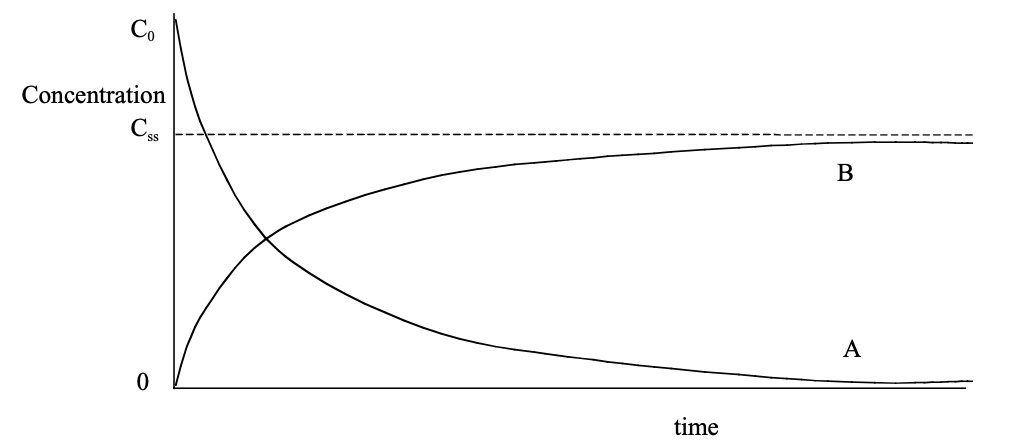
  • This relationship is commonly referred to as a drug wash-out curve (curve A below)
  • The wash-out curve starts at C0 and is asymptotic with zero

  • Drug wash-in and wash-out curves

Drug wash-in curve

  • The way that plasma concentration increases with time during an infusion of constant rate is termed a wash-in curve (curve B above)
    • It is also a negative exponential curve (because the rate of change of concentration decreases with time)
    • A wash-in curve starts at the origin and rises in a negative exponential fashion
    • It is asymptotic with the concentration at steady state (Css)
    • It has the equation: C = Css.(1 - e-kt)
    • For both the wash-in and wash-out curves, the rate constant for elimination is k

Euler's number: 'e'

  • A mathematical constant that is the base of the natural logarithm
  • It has a value of approximately 2.71828
  • Semi-logarithmic transformation of the concentration-time curve to a log(concentration)-time curve makes it a linear decay
  • This makes it easier to mathematically model and derive certain information:
    • Initial concentration (C0) - intercept with the y-axis
    • Rate constant (k) - gradient of the line
    • Time constant (τ) - reciprocal of k (i.e. τ = 1/k)
    • Half-life (t1/2) - time taken for concentration to fall to half the original concentration
      • t1/2 = ln(2)τ, or
      • t1/2= 0.693 x τ (i.e. 0.693 = ln(2))
    • Volume of distribution (VD) - the theoretical volume into which the initial dose distributes in order to produce the measured plasma concentration (VD = dose/C0)
    • Clearance (Cl) - the volume of plasma from which the drug is completely cleared per unit time (Cl = VD x k)


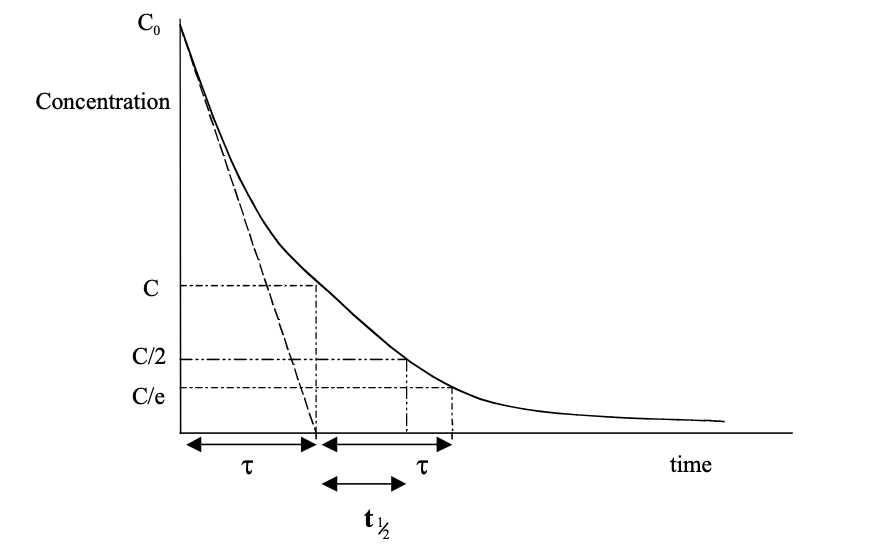
Time constant graph
  • For an exponential process, the time constant (τ) is the time taken for the plasma concentration of a drug to drop to zero if the initial rate of elimination continued
  • One time constant is the time taken for the plasma concentration to fall by a factor of e (i.e. to 37% of its initial value)
  • The time constant (τ) is the inverse of the rate constant (k):
  • τ = 1/k

  • The consequence of this is that the concentration of drug in the plasma falls by the same proportion over equal time periods
  • After one time constant, the concentration falls from C to C/e
    • This represents the process being 63% complete
  • After three time constants, the process is >99% complete
  • As clearance is the product of the rate constant 'k' and the volume of distribution, the time constant can also be expressed in these terms

  • The half life (t1/2) is the time taken for the plasma concentration to fall by a factor of a half
  • The half life is shorter than the time constant:
  • t1/2 = 0.693 x τ

  • After one half life, the plasma concentration falls from C to C/2
  • After four half lives, the plasma concentration is 94% less than the original
  • After five half-lives, the process is >95% complete