- Noradrenaline is a naturally occurring catecholamine sympathomimetic
- It is highly selective for the ɑ1 adrenoreceptor
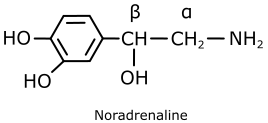
- Presents as a clear solution containing 0.2 - 2.0mg/ml noradrenaline acid tartrate (equivalent to 0.1 - 1.0mg/ml of noradrenaline)
- Presents as a L(-, R) noradrenaline as the D(+, S) enantiomer is 10x less potent
- Contains the preservative sodium metabisulfite
- Preparation has a pH of 3.5-4.0 as noradrenaline is degraded by alkaline environments
- Used as an intravenous infusion to increase systemic vascular resistance
- Ideally infused through a central venous cannula although regimens for peripheral infusion exist
- Should not be used as a bolus as can cause severe hypertension
- No oral bioavailability
- pKa 8.85
- VD of 0.12L/kg
- 25% protein bound
- Uptake 1
- The main mechanism of noradrenaline inactivation
- Active uptake back into the nerve terminal by a high-affinity transport system
- Deaminated by MAO (and COMT although it isn't present in sympathetic nerves) or recycled into storage vesicles
- Blocked by cocaine
- Uptake 2
- A less important route of inactivation
- Diffusion away from the nerve
- Reaches systemic circulation in this way
- Is metabolised by COMT to inactive metabolites VMA, normetadrenaline and MHPG
- These are then excreted in the urine
- Short half-life (2mins) due to rapid metabolism
- Unlike adrenaline and dopamine, up to 25% taken up as it passes through the lungs
- Increased PVR
- No bronchodilatory effect
- The effects of the systematically infused noradrenaline are slightly different from the endogenous hormone
- Effects (predominantly ɑ1 effects) include:
- Peripheral vasoconstriction
- Increased systolic and diastolic blood pressure (in an essentially linear dose-response fashion)
- Reflex bradycardia (conversely, the endogenous hormone causes tachycardia and a rise in cardiac output)
- A reduction in cardiac output due to reduced HR
- Increased myocardial oxygen consumption
- Vasodilation of coronary circulation and therefore increased coronary blood flow
- Some ɑ2 effects on tiny pre-capillary arterioles
- Compared to adrenaline, noradrenaline has less β2-adrenoreceptor activity
- In the failing heart that's relying on β2-agonism, it may be a less effective inotrope than adrenaline
- Renal and hepatic blood flow falls due to vasoconstriction
- Reduced blood flow to the pregnancy uterus may lead to foetal distress
- May exert a contractile effect on the uterus
- Should be used with caution in those taking MAO-Is as its effects may be exaggerated and prolonged