FRCA Notes


Opioid-Induced Ventilatory Impairment


  • Opioid-induced ventilatory impairment (OIVI) is:
  • Type 2 respiratory failure associated with opioid administration and high arterial partial pressure of CO2 ± hypoxaemia

  • The incidence of OIVI in the perioperative period is difficult to ascertain, owing to heterogenous definitions and difficulty correlating surrogate markers of respiratory function and PaCO2
  • Reported rates of post-operative OIVI range from 0.04% - 41%

  • Opioids have multiple negative impacts on respiratory function which can potentially lead to severe respiratory depression:
    • Depression of the respiratory centre in the brainstem, disrupting the generation of the normal respiratory rhythm and reducing alveolar minute ventilation
    • Reduced oropharyngeal muscle tone, resulting in upper airway obstruction
    • Negatively affect both central and peripheral chemoreflex loops
    • Depression of the hypothalamus, leading to sedation via increased arousal thresholds
  • These effects are primarily related to MOP receptor agonism within the respiratory network (pons, medulla) and carotid bodies (peripheral chemoreceptors)

Progress of respiratory changes following opioid overdose

  • Follows a stereotypical pattern
    1. Irregular breathing
    2. Periodic or cyclic breathing
    3. Gasping
    4. Full cessation (i.e. apnoea)
  • In some cases abrupt apnoea occurs without other warning signs
  • Apnoea leads to asphyxia (low arterial oxygen tension but high arterial carbon dioxide tension) and potentially cardiac arrest

  • Opioids affect multiple areas influencing control of ventilation:
    • The pre-Botzinger complex (medulla) which is essential for respiratory rhythm generation
    • Parabrachial complex (the Killiker-Fuse and parabrachial nuclei), which sustains upper airway patency, integrates sensory input from chemoreceptors and adjusts ventilation in response to arterial oxygen and carbon dioxide levels
    • Phrenic pre-motor and motor neurons; a direct effect at high opioid doses which depresses phrenic motor output

Effects of opioids on ventilatory control; the hypercapnic ventilatory response (HCVR)
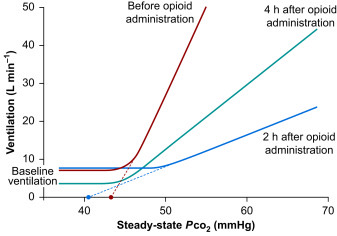

Hypercapnoeic ventilatory response graph

Adapted from Opioid-induced respiratory depression (BJA Education, 2024)

  • The HCVR (i.e. response to inhaled carbon dioxide) is a sensitive measure of the effects of opioids
  • In the absence of opioids, a the HCVR graph (of steady-state PCO2 vs. ventilation) is 'hockey-stick' shaped
    • The flat part of the curve demonstrates CO2-insensitive ventilation, i.e. baseline ventilation before a 'ventilatory recruitment threshold' is reached
    • The linear, increasing part of the curve is the HCVR; it is described by both a slope (i.e. gradient) and an apnoeic threshold

  • Opioids effect the HCVR graph by:
    • A (slow) decrease in baseline ventilation
    • Shifting the curve to the right i.e. higher levels of PCO2 are required to trigger the ventilatory recruitment threshold
    • A reduction in the gradient of the HCVR i.e. less potent ventilatory response in the presence of opioids

Patient factors

  • Data from the PRODIGY study demonstrated that among post-operative patients receiving potent opioids the risk of at least one OIVI event was 46%
  • This lead to the creation of the PRODIGY risk-prediction tool
  • Such factors include:
    • Advanced age
    • Male gender
    • Opioid naive patient
    • Known sleep-disordered breathing or high STOP-BANG score
    • Co-existing heart failure
  • High-risk patients have a 6x higher risk (odds ratio) of respiratory depression compared to low-risk patients

  • Other risk factors not included in the PRODIGY score include:
    • Pathologies which may influence respiratory function e.g. obesity, respiratory diseases, neurological diseases
    • Pathologies which may influence opioid pharmacokinetics e.g. renal impairment, genetic variations in opioid metabolism
    • Diabetes mellitus
  • Many patients who develop OIVI have no identifiable risk factors and all patients receiving opioids post-operatively must be considered to be at risk

Opioid tolerance

  • Chronic opioid users have a four-fold decrease in opioid sensitivity to respiratory depression compared with opioid-naïve patients
  • However:
    • OIVI tolerance develops more slowly than analgesic tolerance, potentially putting said patients at higher risk
    • Individuals with opioid tolerance will use higher opioid doses, increasing risk of overdose
    • Opioid tolerance is dynamic and may decrease during a period of abstinence (e.g. inpatient stay)

Type of opioid

  • Opioids can be classified by their affinity for the MOP receptor
  • Based on the affinity constant Ki, they can be grouped as:
    • High affinity (Ki<1) e.g. buprenorphine, sufentanil, carfentanil
    • Intermediate affinity (Ki 1-25) e.g. fentanyl, methadone, hydromorphone
    • Low affinity (Ki >25) e.g. oxycodone, codeine
  • In general, opioids with a higher MOP receptor affinity display both:
    • Greater respiratory depression
    • Greater resistance to displacement from the receptor by antagonists such as naloxone
  • However, overall the dose of opioid delivered (rather than intrinsic MOP receptor affinity) is the factor which most determines the consequent effects on ventilation

Opioid prescribing

  • Use age-adjusted opioid doses initially to accommodate increased risk in elderly patients
  • Avoid opioid infusions
  • Avoid using more than one opioid or formulation
  • Use immediate-release opioids, not modified-release or long-acting formulations
  • Avoid co-administering sedatives e.g. gabapentinoids, benzodiazepines
  • Use standardised order sets which link opioid prescribing to monitoring and actions to take in cases of over-sedation/OIVI

Analgesic delivery

  • Use multi-modal opioid-sparing analgesic approaches, including on discharge
  • Titrate opioid delivery to functional outcomes rather than unidimensional pain scores
  • Measure sedation scores in all patients and respond appropriately

Education

  • Education about OIVI recognition and management for healthcare professionals
  • Education for patients and carers about avoiding sedatives, reducing opioids after discharge and recognising symptoms of OIVI

  • Harm from OIVI is preventable in the majority of cases with early detection and management
  • Recommendations include:
    • Sedation levels, which are the most reliable clinical marker of OIVI
    • Continuous CO2 monitoring e.g. capnography, although is commonly limited to higher-acuity settings and may not correlate well with PaCO2
    • Routine use of pulse oximetry, although hypoxaemia is a very late sign of hypoventilation, especially if the patient is receiving supplemental oxygen
    • Respiratory rate, although it is poorly reliable as a surrogate marker of OIVI/PaCO2

  • The non-selective opioid antagonist naloxone is the first-line treatment for pharmacological reversal of OIVI (and other opioid toxicity)
  • It works well for perioperative OIVI because in this patient cohort the concentration of opioid molecules at the receptors is usually only just above the threshold for respiratory depression
  • Therefore low, incremental doses (up to 400μg) of naloxone can restore respiratory activity without compromising analgesia
  • The relative short duration of action of naloxone compared to long-acting opioids, or large doses of short-acting opioids, may lead to failure of treatment (20-50%) and re-narcotisation
  • Other issues with naloxone include:
    • Triggering opioid withdrawal in those using long-term opioids either medically or as part of an opioid use disorder
    • Limited ability to displace high-affinity opioids, or high-dose intermediate affinity opioids, from the MOP receptor unless large doses are given
    • Compromised efficacy if there are non-opioid respiratory depressants exerting an effect too e.g. benzodiazepines, anti-depressants, gabapentinoids, alcohol

Newer developments

  • Long-acting opioid receptor antagonists e.g. nalmefene, methocinnamox; useful for OIVI from overdose in the context of opioid use disorder but less useful for perioperative practice

  • Potassium channel blockers, which stimulate the carotid bodies into mimicking the physiological response to hypoxia e.g. doxapram, ENA-001

  • Drugs which stimulate the central respiratory network, exciting the respiratory rhythm generator e.g. ketamine, AMPAR-receptor agonists (a.k.a ampakines) e.g. CX717