FRCA Notes


Pharmacodynamic Interactions


  • Pharmacodynamic interactions can be broadly classified as direct or indirect
    • Direct interactions e.g. those such as naloxone/opioids or flumazenil/benzodiazepines
    • Indirect interactions e.g. adrenaline and enoximone, both of which increase intracellular cAMP but via different mechanisms (GPCR agonism vs. PDE inhibition)

Summation

  • The actions of two drugs are additive, but each has an independent action of its own e.g. midazolam and propofol

Potentiation

  • The action of one drug is amplified by the second drug, which has no separate action of its own
  • For example, magnesium's effect on NMBA at the nAChR at the NMJ
  • E.g. probenecid reduces the renal excretion of penicillin

Synergism

  • The action of the two drugs is greater than would be expected from a purely additive effect
  • E.g. remifentanil and propofol
  • E.g. sulphonamide antibiotics and trimethoprim; both are bacteriostatic but when given together become bactericidal
  • E.g. clonidine and opioids

Antagonism

  • The action of the two drugs is opposing
  • E.g. flumazenil and benzodiazepines (direct effect)
  • E.g. neostigmine and non-depolarising NMBA's (indirect effect)
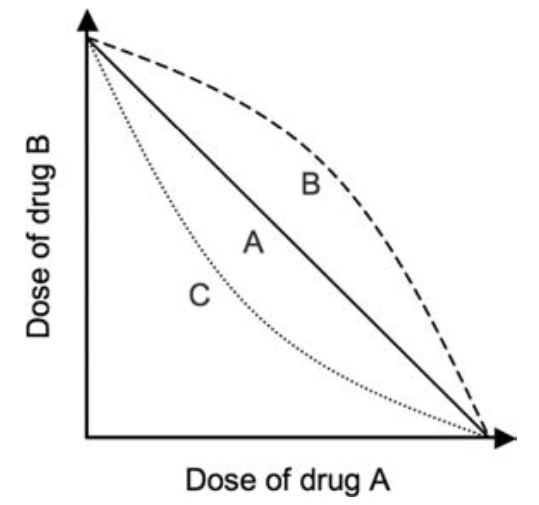

Isobologram

Adapted from Physics, Pharmacology and Physiology for Anaesthetists

  • The isobologram is a graph demonstrating the amount of Drug B required in the presence of increasing amounts of Drug A to maintain a constant end-effect
  • Line A: the two drugs are additive; as more of Drug A is introduced, less of Drug B is introduced in a linear fashion
  • Line B: the two drugs are antagonistic; as more of Drug A is introduced, more of Drug B is required to maintain a constant end effect compared to if they were additive
  • Line C: the two drugs are synergistic; as more of Drug A is introduced, less of Drug B is required to maintain a constant end effect compared to if they were additive.