FRCA Notes


Stabilisation and Transfer of the Critically Ill Child

Curriculum

The most relevant curriculum item is "Explains the principles of stabilisation and safe transport of critically ill children and babies".


  • Paediatric critical care in the UK is centralised into tertiary paediatric critical care units (PICUs)
  • Critically ill children can present to any hospital with an ED or walk-in centre, so non-tertiary hospitals must be able to:
    • Resuscitate and stabilise
    • Refer
    • Maintain critical care until the transport team arrives
    • Perform time-critical transfers themselves when needed

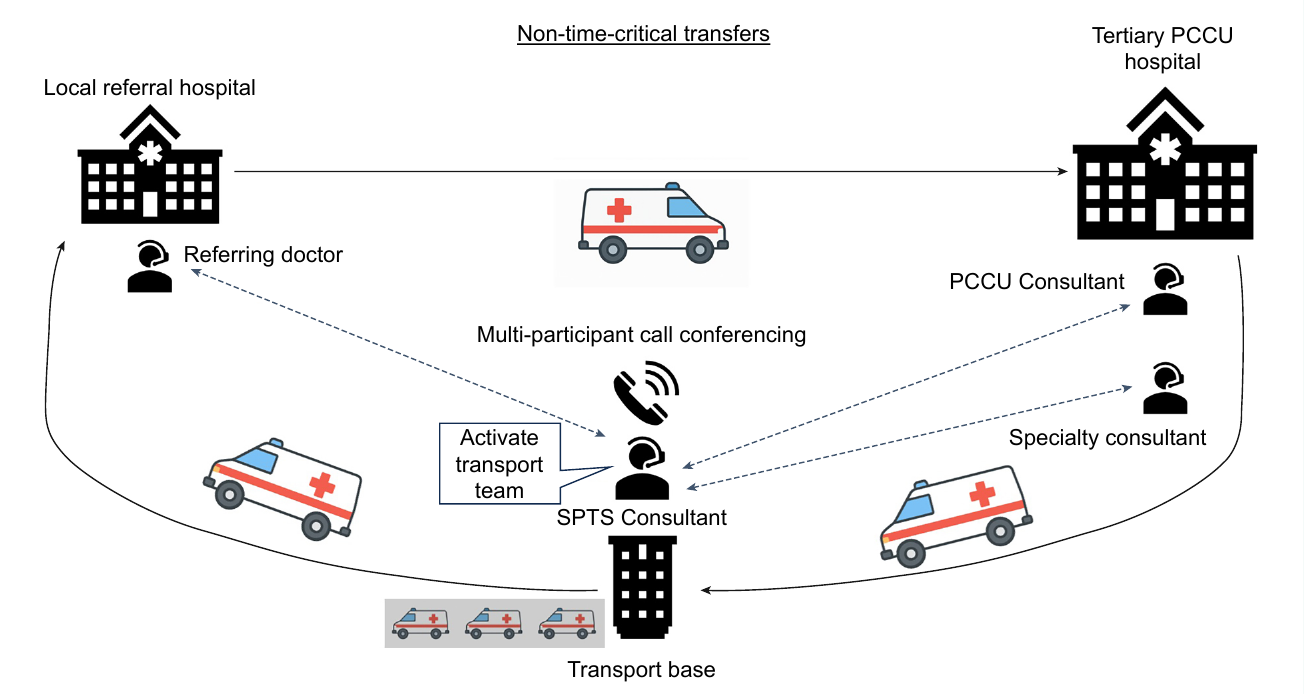
  • Operational oversight of paediatric critical care networks is provided by Operational Delivery Networks, while Specialist Paediatric Transport Services undertake the majority of PICU transfers

  • Standards for non-time-critical transfers:
    • Mobilise within 30 minutes of the decision to transfer
    • At the bedside within 3 hours

Referral and transport process for a non-time-critical paediatric transfer

Adapted from Paediatric stabilisation and transfer. Part 1: preparation and standards of care

Principles

  • Structured APLS (ABCDE) assessment to minimise errors and missed diagnoses
  • Balance necessary interventions and imaging against delaying transfer
  • Use checklists, especially for emergency paediatric intubation
  • Senior input throughout: paediatric, anaesthetic and ED consultants with formal handovers as leadership changes
  • The child should not leave until the airway is safe with adequate vascular access and monitoring

Infusions

  • Standardised concentrations categorised by weight (2023 national statement); bespoke weight-based concentrations are considered unsafe
  • Smart pumps with drug libraries
  • Use the SPTS drug chart; matching concentrations with the SPTS and PCCU reduces errors at handover

Pre-arrival checklist


Patient preparation Documentation and communication
ETT secured with tape; confirm it does not move ("push test") Ready to give verbal handover
CXR to confirm ETT position (tip at T2 ideal for transfer) Copies of notes, results and drug chart
Stable on a suitable mode of ventilation Transfer letter
Recent blood gas and glucose Imaging viewable at receiving hospital
Gastric tube Safeguarding concerns documented
Minimum of 2 points of IV access Maternal blood sample (babies under 4 months)
Infusions in labelled 50 ml syringes on the SPTS drug chart Parents updated
Regular pupil observations


Principles

  • Conditions where time to definitive treatment significantly affects outcome; usually life-, limb- or organ-threatening
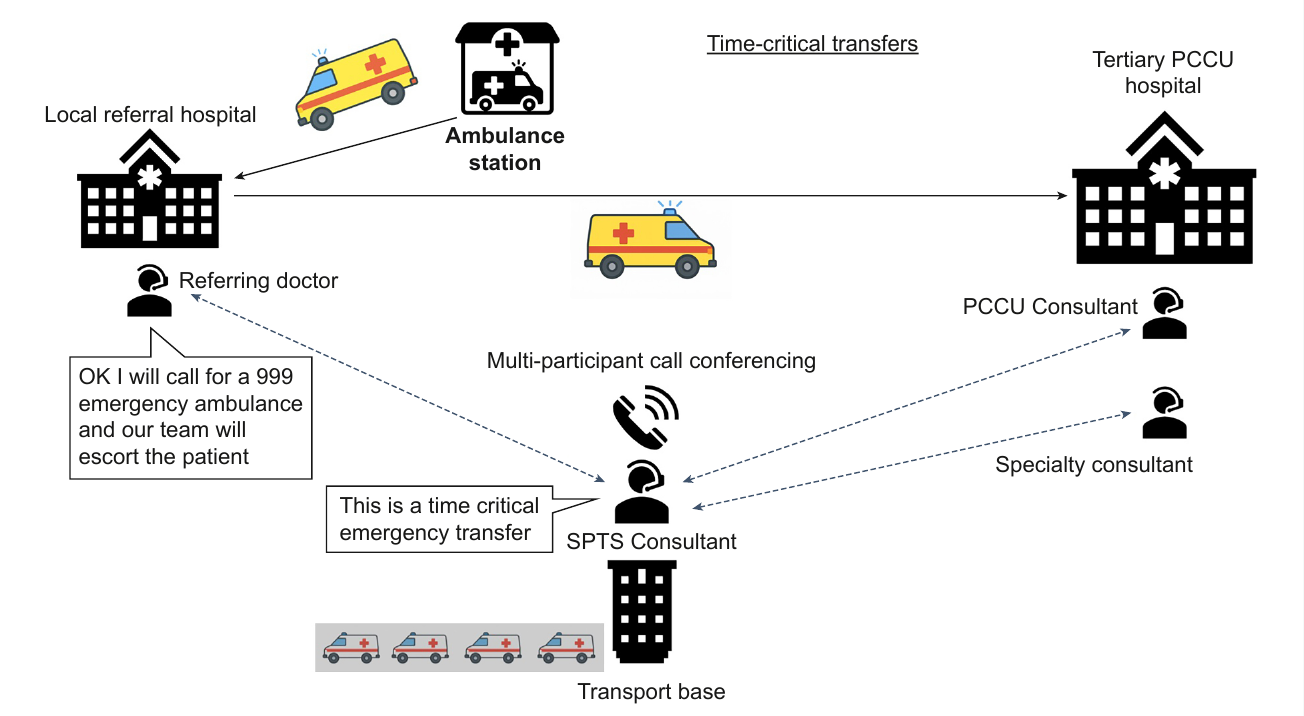
  • Undertaken by the referring hospital team as waiting for the SPTS would cause delay
  • The benefit of a rapid transfer must outweigh the risk of a less experienced, non-specialist team
  • The SPTS consultant can still advise, and may assist if a team is nearby or the local team is overwhelmed

Category Examples of time-critical conditions
Neurological Blocked VP shunt; hydrocephalus; expanding space-occupying lesion; critically raised ICP; severe head injury; acute ischaemic stroke
Surgical Major trauma; major burns; malrotation/volvulus; intussusception; perforation; testicular torsion; ischaemic limb
Cardiac Duct-dependent lesion not responding to dinoprostone
Metabolic Hyperammonaemia

Team and preparation

  • At least 2 senior clinicians, ideally trained in paediatric critical care, transfer and advanced airway management
  • STOPP (Safe Transfer of the Paediatric Patient) tools, available from the SPTS:
    • Risk assessment that determines team composition
    • Checklists for equipment, drugs and fluids
    • Prompts for communication, clinical and administrative tasks
  • Equipment checked daily, with recorded regular training
  • Pre-departure checks reinforce a shared mental model, much like a pre-anaesthetic brief
  • Ensure a safe local service: if a consultant leaves, arrange senior cover (e.g. second on-call); plan for theatres being occupied

ACCEPT approach (ALSG)


Step Key points
Assessment ABCDE assessment; decide who will transfer
Control Clear leadership; formal handovers as control changes
Communication Structured (SBAR), recorded calls, documented discussions
Evaluation Senior decision that transfer is appropriate; choose mode of transport
Preparation and packaging Secure patient and equipment; batteries, oxygen; pre-departure checks
Transport Mobile intensive care; update receiving unit with ETA

Ambulance

  • Almost all UK time-critical paediatric transfers are by road
  • Interfacility transfers are mapped to ambulance response categories:
    • Usually Category 2 (18-minute target response); transport only
    • Escalate to a Level 1 response (paramedic crew, 7-minute target) if additional clinical help is needed
  • Hospitals and ambulance providers should have an agreed process for requesting a non-SPTS ambulance

Hazards during transport

  • Acceleration, deceleration and cornering forces; small babies and under-resuscitated children are most affected
  • Blue lights and sirens increase accident risk and physiological stress; risk assess with the crew and favour a smooth, steady drive

Referral and transport process for a time-critical paediatric transfer

Adapted from Paediatric stabilisation and transfer. Part 1: preparation and standards of care


Neurosurgery, trauma and burns

  • Protocols and drugs immediately available to treat raised ICP and major haemorrhage
  • Proformas for burns triage, assessment and fluid resuscitation

Duct-dependent congenital heart disease

  • All hospitals must stock dinoprostone (prostaglandin E2) to maintain or reopen the ductus arteriosus, with a regionally agreed protocol
  • Ventilated neonates and infants with cardiac lesions may need FiO2 below 0.3, so the transport ventilator must allow this

Hyperammonaemia

  • Time-critical transfer for consideration of haemodiafiltration
  • Ammonia scavenging drugs must be started within 30 minutes of the decision to treat

Neonates and small infants

  • Under 3 kg requires specialist equipment and expertise: involve the local neonatal team or regional neonatal transport service early
  • Transport incubators or 'babypods' may be needed

Resuscitation (Resuscitation Council UK)


Immediately available in paediatric sizes Accessible for prompt use
Oro- and nasopharyngeal airways; face masks Cuffed and uncuffed tracheal tubes
Suction; Magill's forceps Supraglottic airways; stylets and bougies
Waveform capnography 2 laryngoscopes; Miller and Macintosh blades
Defibrillator with paediatric pads Infusion and extension sets
Cannulas; intraosseous kit; CVC kits 0.9% sodium chloride and 10% dextrose
Ultrasound/echocardiography

  • Trolleys standardised across the organisation, with a local risk assessment for anything extra
  • Intraosseous kits on every resuscitation trolley; all clinicians trained in their use
  • Resuscitation drugs (always including adrenaline) must not be locked away; stored in tamper-evident containers with daily documented checks
  • Immediate access to algorithms and resource tables for equipment sizes and drug doses

Airway

  • Non-specialists should focus on good basic airway support first
  • Clinicians competent in paediatric intubation should use cuffed tubes
  • Standardised paediatric difficult airway trolley with a videolaryngoscope suitable for all ages; an adult trolley is not sufficient
  • Cuff pressure manometer to keep cuff pressure below 20 cmH2O

Transport

  • Transport ventilator suitable for any size, with regular training and protocols for circuit set-up by age (reducing dead space, humidification, non-invasive support)
  • Portable monitoring with configurable paediatric alarm limits
  • Paediatric transfer 'grab bag' with a resource folder: SPTS drug chart, STOPP tool, observation charts, guidelines and regional contact numbers
  • Patient restraint:
    • Over 2.5 to 3 kg: adult transport trolley with an age and weight-appropriate child restraint
    • Under 2.5 kg: babypod or transport incubator
    • Vacuum mattress if a specific harness is unavailable

  • Caregivers can choose their level of presence during emergencies, provided safety and teamwork are maintained; a family support worker can help
  • Offer the chance to travel with their child, after assessing:
    • Patient stability
    • Parental behaviour and separation anxiety
    • Space in the ambulance
  • Brief any travelling parent on the transfer and safety procedures
  • Those not travelling should not follow the ambulance; give them the address and contact details of the destination ward
  • Access to support e.g. social workers, chaplaincy, counselling