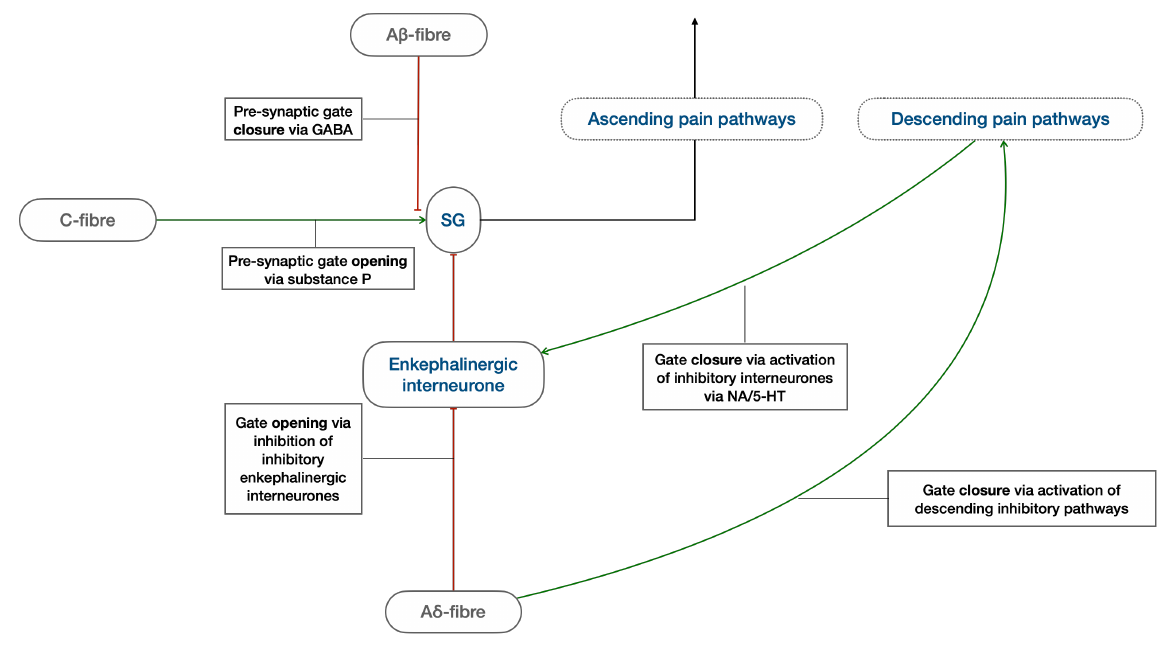
The gate control theory was described by Melzack and Wall in 1965
It describes modulation of nociceptive transmission at spinal cord level, which is itself influenced by descending pathways
Although since refined, it explains why non-painful stimuli can reduce pain, and led to the development of TENS
Transmission of a painful stimulus from first to second order neurones occurs through a 'gate' in the dorsal horn
The gate is formed by inhibitory interneurones in the substantia gelatinosa (SG)
These interneurones are themselves stimulated or inhibited by other afferent and descending inputs, which determines whether the gate is open or closed
The gate is opened by
C fibres: pre-synaptically via substance P
Aδ fibres: post-synaptically, by inhibiting the inhibitory enkephalinergic interneurones
The gate is closed by
Aβ fibres: pre-synaptically, via GABA-mediated inhibition
Descending inhibitory pathways from the PAG/NRM (5-HT) and locus coeruleus (noradrenaline)
These activate enkephalinergic interneurones, inhibiting onward transmission
Aδ fibres, indirectly: collaterals stimulate the PAG and so enhance descending inhibition
Inputs which open and close the pain gate in the substantia gelatinosa (SG)
Aβ stimulation
'Rubbing it better': touch and pressure activate Aβ fibres, closing the gate