the ratio of the concentration of a substance present in one phase compared to another, where the phases are of equal volume, in equilibrium and at a stated temperature
Relevant to inhaled anaesthetics are the blood:gas and oil:gas coefficients
There are both types of Ostwald coefficient, i.e. they are independent of partial pressure
At steady state, PAlveolus ⇄ Parterial ⇄ PBrain
Therefore, the alveolar partial pressure of a gas gives an indirect measure of its partial pressure in the brain
The blood:gas partition coefficient is the ratio of a substance dissolved in blood and gas phases, at equilibrium, where the phases are of equal volume and at standard temperature
An agent with a high B:G coefficient pass easily from alveoli into blood
Therefore it exerts a lower alveolar partial pressure (as it is unable to generate a concentration gradient)
Therefore there is slower onset/offset
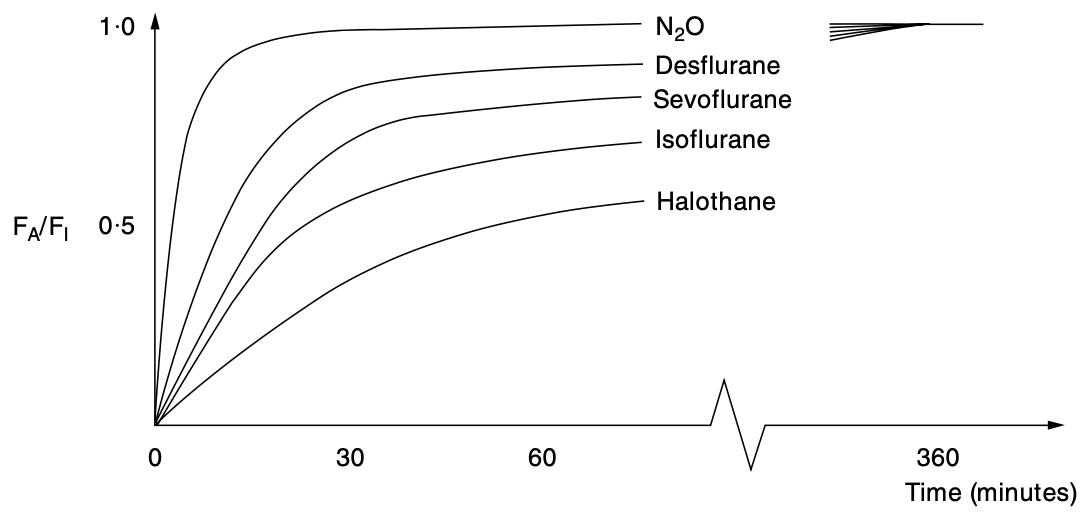
Wash-in Curve
Adapted from Physics, Pharmacology and Physiology for Anaesthetists
This describes the ratio of inspired to alveolar gas concentration (FA/Fi) over time
It graphically demonstrates the effect of B:G coefficient on onset time for different agents
The graph is a negative exponential curve (inverted rectangular hyperbola) with the formula y = e-kt
The ratio of alveolar to inspired concentration is plotted on the y-axis
Agents with a low blood:gas partition coefficient will reach equilibrium more rapidly
Note that nitrous oxide has more rapid rise in FA/Fi than desflurane even though desflurane has a lower blood:gas partition coefficient - this is due to the second gas effect
Oil:gas partition coefficient is the ratio of a substance dissolved in oil and gas phases, at equilibrium, where the phases are of equal volume and at standard temperature
An agent with a high O:G coefficient is more lipid soluble and stays in the 'oily' state
It tends to pass readily into the brain and fat stores, i.e. is more potent
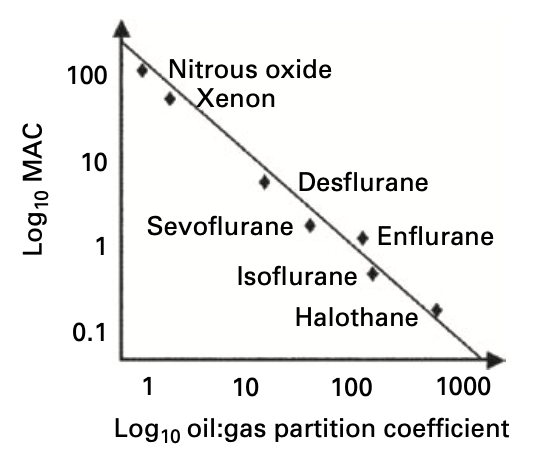
O:G coefficient is inversely related to MAC
However, after prolonged administration, wake up is slow due to mass of agent in fat stores
Log(MAC) vs. log(O:G coefficient) - The Meyer Overton hypothesis: