- These receptors are membrane-bound systems that transduce a ligand-generated signal into an intracellular signal
- Metabotropic receptors can be classified as:
- G-protein coupled receptors
- Tyrosine kinase linked receptors
- Guanyl cyclase systems
G-protein coupled receptors
- G-protein coupled receptors are membrane-bound, serpentine proteins consisting of seven helical regions
- They are associated with G-proteins; heterotrimeric proteins which act as universal transducers in bringing about intracellular change from extracellular stimulus
- In addition to transducing the signal, the G-protein system amplifies the signal
- One receptor can stimulate multiple G-proteins (ratio thought to be 1:100)
- One G-protein can activate several intermediate messengers
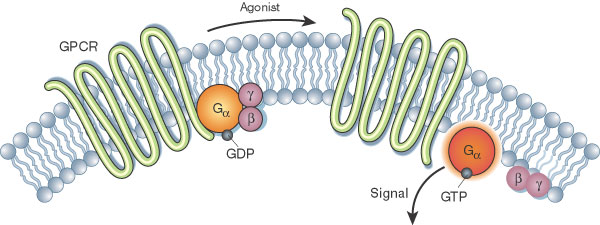 Mechanism of action
- An extracellular ligand binds the receptor, inducing conformational change
- This increases the chance of coupling with G-proteins
- G-proteins are bound by GDP at rest, but once coupled (activated) by the receptor the ɑ-subunit binds GTP
- The ɑ-GTP complex then acts on effector proteins or ion channels, for example:
- Activation of adenylyl cyclase - Gs ɑ-subunits (e.g. β-adrenoreceptors)
- Inhibition of adenylyl cyclase - Gi ɑ-subunits (e.g. ɑi - adrenoreceptors)
- Activation of phospholipase C - Gq ɑ-subunits (e.g. ɑ1 - adrenoreceptors, M1/3/5 receptors, AT2 receptors)
- Inhibition of N-type Ca2+ channels - morphine acting on opioid receptors
- The ɑ-subunit acts as a GTPase by performing these actions, forming GDP and combining with the β/Ɣ subunits to reform an inactive G-protein
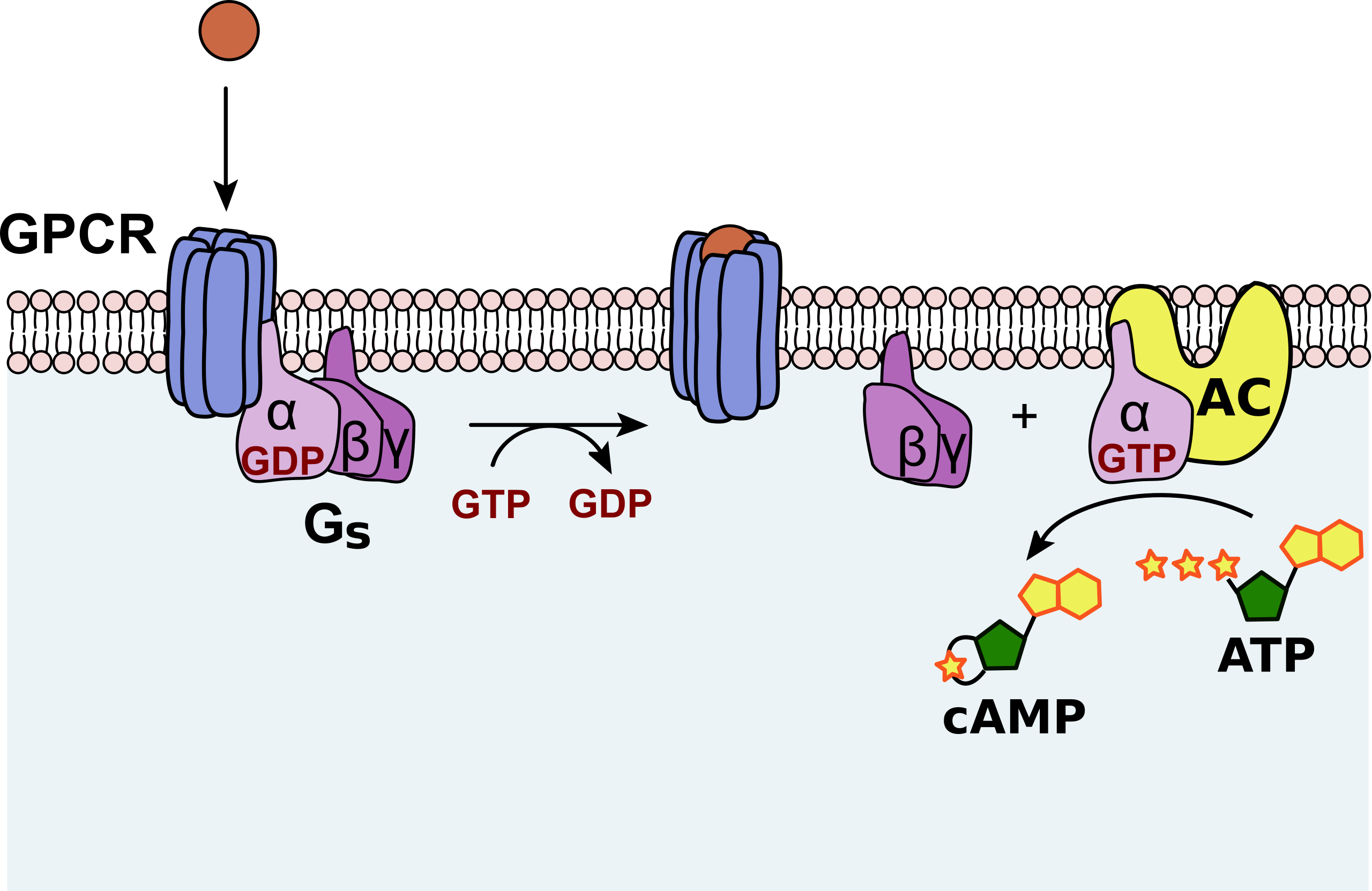 Adenylyl cyclase
- Adenylyl cyclase is a membrane-bound enzyme, although is also found in the cytoplasm
- It catalyses the formation of cAMP from ATP
Cyclic AMP (cAMP)
- cAMP activates protein kinase A, which is responsible for subsequent biochemical effects
- cAMP is broken down by phosphodiesterases (PDE, of which there are five subtypes)
- Inhibition of PDE can therefore increase intracellular cAMP and exert biochemical effects
- Examples of PDE inhibition include:
- Non-specific inhibition e.g. theophylline
- PDE-III specific inhibition e.g. milrinone
- PDE-V specific inhibition e.g. sildenafil
Phospholipase C
- G-protein coupled receptors associated with Gq ɑ-subunits do not act via the adenylyl cyclase pathway
- They instead activate the enzyme phospholipase C (PLC), which cleaves the phospholipid PIP2 into two messengers:
- Inositol triphosphate (IP3), which causes calcium release from the endoplasmic reticulum
- Diacylglycerol (DAG), which activates protein kinase C
- Examples of tyrosine kinase receptors include the insulin receptor and the growth factor receptor
- The insulin receptor has two alpha and two beta subunits
- Insulin binds to the alpha subunits
- The beta subunits are membrane-spanning
- When insulin binds, intracellular tyrosine residues on its beta-subunits are phosphorylated and become active tyrosine kinases
- Atrial natriuretic peptide exerts its action via membrane-bound receptors that have intrinsic guanylyl cyclase activity
- This increases cGMP levels and acts as a second messenger by phosphorylation of intracellular messengers
- Nitric oxide (NO) exerts its effects by stimulating cytosolic guanylyl cyclase, thus increasing intracellular cGMP
- Steroid hormones and thyroid hormones act through intracellular receptors to alter RNA and DNA expression
- They indirectly alter production of cellular proteins, and therefore have a much slower effect
- Their receptors are cytoplasmic ligand-regulated transcription factors
- Binding of the ligand (hormone) induces a conformational change, activating the receptor and permitting translocation to the nucleolus
- Examples of receptors which act as regulators of gene transcription include:
- Steroid hormone receptors
- Thyroid hormone receptors
- Nuclear peroxisome proliferator-activated receptor (to which pioglitazone binds)
Adrenosteroid hormones receptors
- Glucocorticoid receptor (GR) - widespread in cells
- Mineralocorticoid receptor (MR) - restricted to epithelial tissue in the renal tubules and the colon
- These cells also contain GR
- Selective MR receptor activation occurs due to the action of 11-β-hydroxysteroid dehydrogenase
- This enzyme converts cortisol to cortisone - cortisone is inactive at the GR receptor