- Standard induction of anaesthesia: 0.6mg/kg provides intubating conditions in 100-120s
- Rapid sequence induction: 1.2mg/kg provides intubating conditions in 60-90s, owing to low potency
- Duration of effect approximately 30-40mins, but is dependent on initial dose as well as patient factors such as hepatic or renal impairment
Rocuronium
Rocuronium
- Rocuronium is a monoquaternary aminosteroid that was developed from vecuronium and has the main advantage of rapid onset
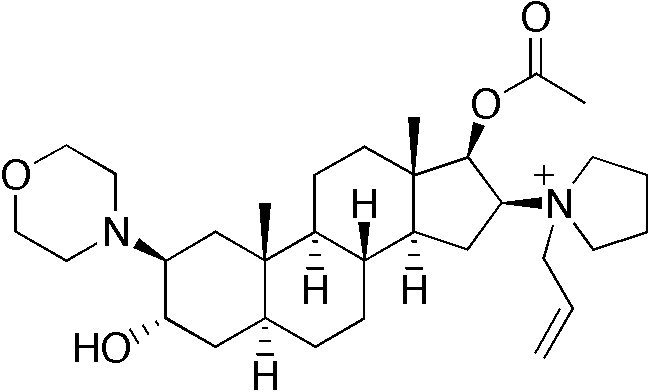
- Presents as the bromide salt i.e. rocuronium bromide
- Colourless solution stored in glass vials at 4'C (i.e. fridge)
- Concentration of 10mg/ml
Distribution
- 30% protein bound
- Low volume of distribution
Metabolism and excretion
- Mainly (30%) excreted unchanged in the bile
- A smaller proportion is excreted unchanged in urine
- Some hepatic de-acetylation occurs
- A small degree of variability in required rocuronium dose (4%) is due to polymorphisms of the gene encoding the OATP1A2 uptake transporter (BJA, 2021)
- Use of magnesium at a dose of 30-50mg/kg can reduce required rocuronium dose by up to 25%
- Hepatic and renal failure will prolong duration of action
Cardiovascular
- Minimal cardiovascular effects compared to other aminosteroids
- RSI doses can contribute to tachycardia
Adverse effects
- Does not cause histamine release
- Pain on injection owing to low pH of solution (approximately 4)
- Anaphylaxis