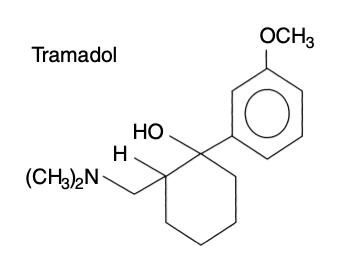
Presentation
- Tramadol presents as a racemic mixture of R-tramadol and S-tramadol
- R-tramadol has MOP receptor affinity 20x that of S-tramadol
- For oral use: tablets, capsules or sachets (50-400mg SR)
- For IV/IM use: a solution of 100mg in 2ml
Mechanism of action
- Tramadol has agonist properties at MOP, KOP and DOP, particularly MOP
- Potency is 10-20% that of morphine's
- Its main analgesic activity is through its inhibition of serotonin and noradrenaline re-uptake
- This promotes activity in descending pathways which inhibit pain transmission
- Acts at other sites via:
- NMDA antagonism
- Nicotinic/muscarinic acetylcholine receptor antagonism
- Stimulation of pre-synaptic serotonin release
Pharmacodynamics
- Overall similar effect to morphine
- Produces less respiratory depression and constipation than morphine at equi-analgesic doses
- Interacts with TCAs and SSRIs as they will also inhibit central noradrenaline and 5-HT re-uptake
- Central neurotrasnmitter re-uptake inhibition can cause seizures and therefore shouldn't be used in those with epilepsy
Pharmacokinetics
- Oral bioavailability 70% (and this may increase to 90% with repeated doses)
- Distribution
- Volume of distribution 4L/kg
- Elimination half life 5-6hrs
- Metabolism in the liver by CYP2B6, CYP2D6 and CYP3A4 enzymes
- Subsequent glucuronidation to a number of metabolites
- Metabolites excreted in the urine