FRCA Notes


Volume of Distribution


  • Volume of distribution is the theoretical volume into which a drug distributes following its administration
  • It is measured in millilitres and abbreviated to VD
  • Volume of distribution doesn't correspond to any physiological volume and can be larger than total body water
  • For example, drugs that are highly lipophilic have a volume of distribution at steady state greater than total body water, e.g. atropine, sevoflurane
  • VD is a volume, although it can be indexed to body weight and expressed as a volume per unit weight e.g. L/kg
  • VD is a constant for a given drug

Factors affecting the volume of distribution of a drug

  • Lipid solubility (higher = higher volume of distribution)
  • Molecular weight
  • Protein binding (higher = higher volume of distribution)
  • How charged a drug is
  • Degree of tissue binding
  • Regional blood flow to tissue

  • In a one compartment model, if we know the drug dose (mg) and the drug concentration at time = 0 (C0; mg/ml):
  • VD = dose (mg) ➗ concentration at time zero (C0)

  • It is, however, not possible to know C0 as mixing of a drug throughout the body is not instantaneous
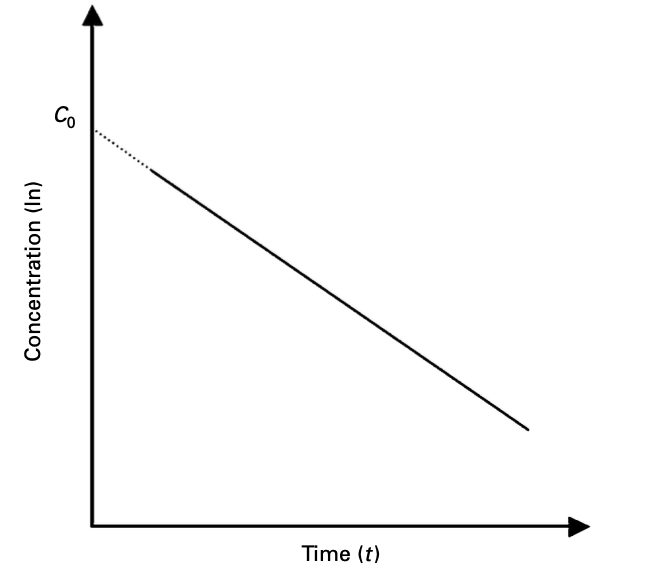
  • Therefore a semi-logarithmic plot of ln(Concentration) vs. time is drawn and C0 extrapolated

  • Concentration-time  graph

Loading dose

  • In a one-compartment model, it is possible to calculate the loading dose to give a desired plasma concentration using VD
  • Loading dose (mg) = VD (ml) x desired plasma concentration (mg/ml)

    LD = VD.C

Maintenance infusion

  • In a one-compartment model, it is also possible to calculate the rate of infusion required in order to maintain a given plasma concentration after a loading dose
  • In order to maintain a steady plasma concentration, the rate of infusion must equal the rate of elimination
  • The rate of elimination is a product of the concentration of a drug and its clearance (C.Cl)
  • Therefore:
  • Rate of maintenance infusion (mg/min) = desired plasma concentration (mg/ml) x clearance (ml.min-1)

    Rinf = C.Cl


  • If no loading dose is given and the rate of infusion is set to match C.Cl, it will take 3 time constants (5 half lives) for the drug to reach steady state i.e. the opposite of the duration it will take to completely eliminate a drug